
can i feed you?
food is the currency of love and living

whenever my dad comes home, he asks me if i’ve eaten yet.
whenever my parents call my siblings they ask, “have you eaten yet?”
whenever i’m getting ready for school, my mom tells me, “kai khai ne ja—eat a bit and then go.”
if i were to dig open either grandmother’s grave, God might just grant them enough life again to ask me, “are you hungry?” even if i were to say no, they’d still offer to clobber some clumps of clay together and knead them into naans; splosh a mound of moist dirt in my hands and say, “say bismillah and blow like isa—it’ll be your earthly bite from jannah, a ma’idah made from mud for a son of adam.”1
i wasn’t around when jesus brought the dead back and breathed sculptures into living birds, but i’ve seen what all of my mothers’ hands can do in a quarter turn of the hour hand—no less a miracle and sign of God.
my mom tells me to marry a girl who’ll feed me everyday. what she means is, “marry a girl who’ll love you everyday.”
i will, mum, Godwilling. and i’ll feed her sometimes too, the way i offer you a spoonful of my dessert and you blink your eyes in bliss. it’s the only thing i know how to make that you don’t (only because you let me have the honor and my sister taught me over the phone).
after a long day of moving boxes and painting parts of the house, there comes dinner time and as i gravitate towards yesterday’s left overs, she directs my attention towards the kitchen with a long, straight, pointing arm and demands in three-year-old articulation that i make “guyanish,” the name she decided for my dessert. nobody has been to guyana, but between us, somehow this spread hails from far away, from where she points to beyond these tiled walls.
i hear from older friends of my brother that when you grow up, friends grow distant even if they live on the same street. if you’re lucky, you might get a call once in a while or rub shoulders in rows every few fridays.
“message the people you miss,” the wise ones say. i do, sometimes. and sometimes i just think about them, and maybe they just think about me too. if only a bird with a bleeding heart would come on early mornings tapping - like lenore’s raven rapping - and tweet to me of beloveds who thought of me the night before.
maybe i should enter my uncle era sooner and start calling my friends:
“hala habibi, wainak? where have you been? come over ya ghali. i’ll brew you some coffee.”
all my life i’ve known love in the morsels i’ve been fed; perhaps it’s time for me to form them with my fingers for others like my mother did tiny triangular boluses of warm khichri for my quick-to-chirp-open-again mouth.
when i think of friends afar, beyond and behind barbed borders, i pray to God to let me feed them someday with my own hands, to make for them bowlfuls of what my mother demands me to make like a toddler, so that for a moment there is nothing but the spoon and the bolus and the bliss—كي تولي همومهمُ وينجلي الضررُ
if i cannot feed yet, then at least i can ask when i call,
“have you eaten yet?”
since my manuscript is still between drafts, do you think i should include this piece? any edits i should make? does it feel sufficiently fleshed or are there some spices missing?
extras:
one.
الود بالود والصد بالصد وقلوبنا عزيزة لاتمشي في طريق الذل فمن استغنى فنحن عنه اغنى ومن بقى فنحن له ابقى ومن كان لنا سكناً كنا له وطناً
today i came across this arabic proverb. many variations exist online, but up to here is mostly consistent across versions.
here’s my translation attempt:
affection is repaid with affection and a shunning with a shunning, and our hearts are honorable—walking not the path of humiliation.
so whoever does without us, then we are more self-sufficient; and whoever stays [for/with us], then we will remain even longer for them; and whoever is for us a home, we will be for them a homeland.
two. i can’t help but mention how what is a language of love for many so often becomes a form of oppression and the slow erosion of a soul when it is made to carry more than it can hold. for my fellow dude bros, it doesn’t matter who cooks and who does the dishes, just make sure those under your wings do not crumble under the weight of your wings.
if the prophet pbuh told abu dharr r.a. to feed his slave from his own food, and clothe his slave from his own clothes, and to not burden him above his capacity, and that if he does, he should help his slave, then i need not point out the obvious about how a companion for life ought to be treated2.
and for dude bros like me who live at home, let’s try to lessen the burdens of our parents. we can start there, for while we may still be under our parents’ wings, God tells us to lower our wings for them. so if a wife and children are to be under one’s wings, then perhaps parents are to ride above one’s wings.
three. prophet ibrahim a.s. would never eat without inviting someone, even a stranger3. as followers of his sunnah, we ought to try to feed others from what we feed ourselves, but the logistics of that can be difficult. an easy solution (that i need to start implementing myself) could be that for every meal we eat, put aside something, a dollar or even less (God rewards you on your effort), and set up an auto-donation to a charity that feeds people, maybe a specific orphanage in town, etc. think of it as monthly deposits to your tax-free-akhirah-investment-account. feeding others, as we know from the pretty famous hadith, is from the “best islam,” and spreading salam. so let’s try to be the best muslims.
peace out,
walyullah
ps — the cool kids here keep writing without capitalizing, so i thought i’d try and see what all the rage is about (why y’all like it lowercase?).
[thumbnail from pinterest]
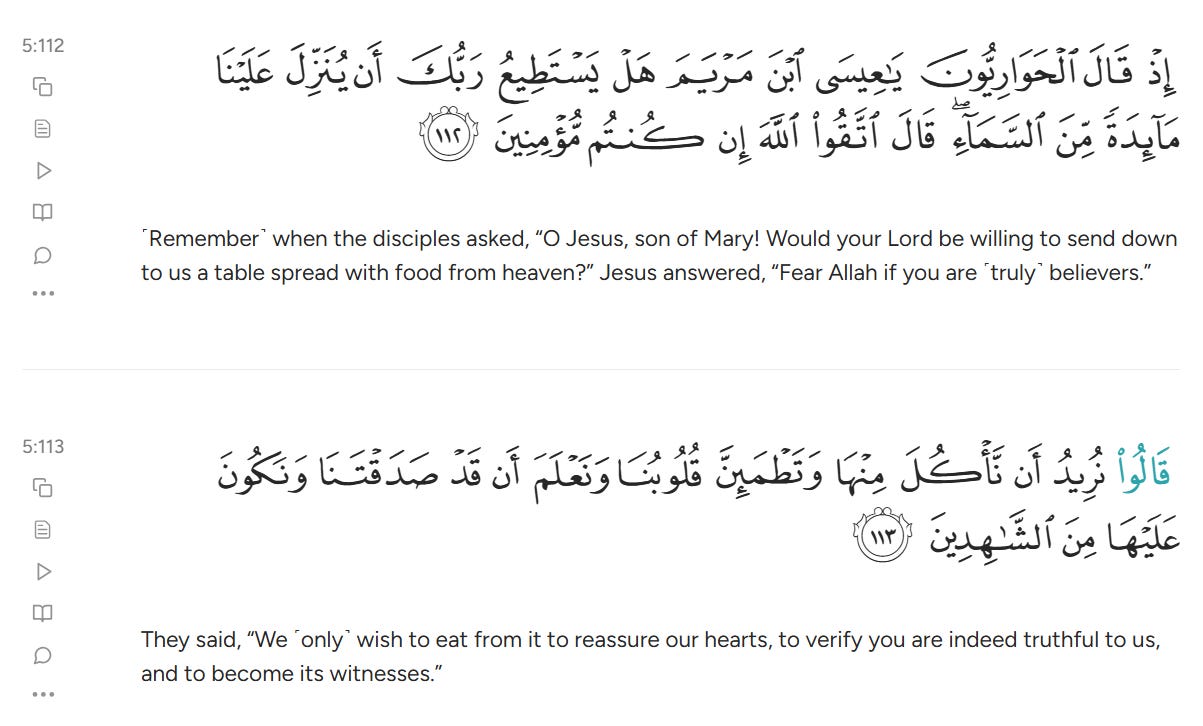
a ma’idah is a platter of food; in reference to surah al-ma’idah where the followers of jesus (a.s.) asked him to ask God for a miracle:
This was stunning. The thread you weave between food, faith, and affection is seamless; it’s as if each line kneads memory and devotion together into something sacred. I especially loved how you reframed “have you eaten yet?”not as a question of hunger, but as an expression of care, lineage, and quiet love passed through generations.
I vote yes for this piece making it into your manuscript. Very interesting that you connected the hadith about abu dharr and lowering one's wings for our parents. Together, they really give a deeper layer of meaning, new perspective. Beautifully written. Jazakallahu khayr.